
A classroom prototype became a real-world accessibility tool

We’re excited to spotlight a powerful story of innovation emerging from UCL’s Human-Computer Interaction MSc and Disability, Design and Innovation MSc programmes. Developed as part of the “Disability Interaction” module, a shared course between the two programmes. This student-led project has grown into a real-world startup addressing one of the most overlooked challenges in accessibility: helping people with sight loss navigate public transport.
In the UK alone, there are an estimated 1.7 million people who aren’t formally registered as visually impaired but still suffer from sight loss severe enough to affect their daily lives. While there are services that connect blind and low-vision users with sighted volunteers and companies via live video and AI do a stellar job supporting users, there’s still a gap when it comes to real-time, hurried scenarios like catching a bus or train.
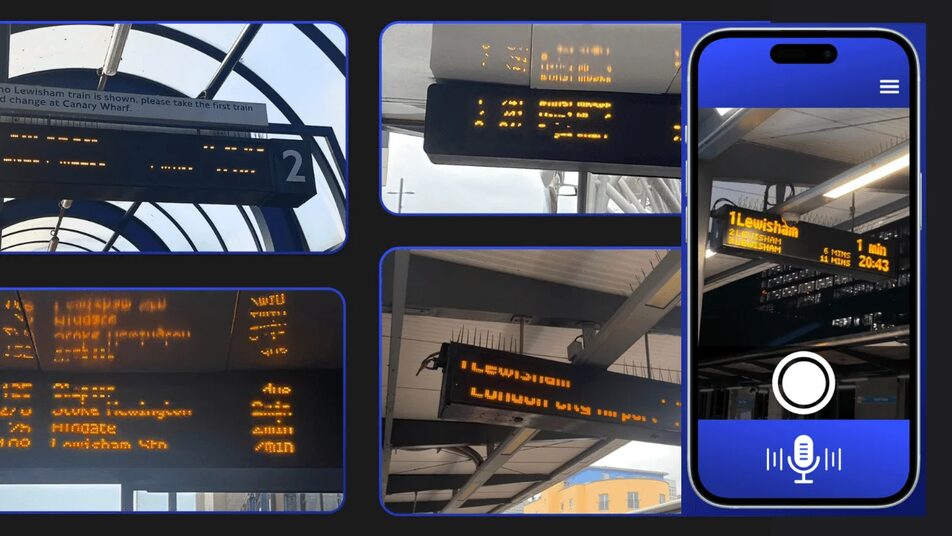
Many people struggle to navigate public transport simply because they can’t read the signage. Zooming in with a smartphone often distorts the text, and mainstream transit apps can lag or miss real-time updates. The result? Missed buses, wrong trains, the risk of getting stranded, and a reliance on strangers. But now there’s a solution.
Founded in March by UCL students, Solora has developed RideOnTime, an app that uses AI to translate transport signage into clear visuals and audio if desired in real time. It offers people with sight loss a dramatically easier way to navigate bus and train stations independently. Solora has already been recognized with awards, including Most Inclusive Product at UCL’s latest Venture Builder Programme and the SustainTech Pitching Competition, winning £1,500 and £1,000, respectively.
Long term, Solora is looking at white-labeling and integrating its solution into existing platforms run by transit authorities. According to Bak, the current UK launch is essentially a pilot to gather data, prove impact, and run focus groups.
“We’re already in conversations with transport authorities about integration, and we’re actively seeking our first client.”
The team is also exploring EU mobility funding opportunities and ways to expand beyond the UK. However, the biggest challenge has been accommodating individuals with varying levels of vision loss; some people are severely visually impaired or blind, and they want to use the app too.
Solora, featured in the article is a direct outcome of this environment where students are encouraged to explore real-world problems and develop inclusive solutions. It’s also a reflection of the work done at UCLIC (UCL Interaction Centre), a world-leading Centre of Excellence in Human-Computer Interaction. UCLIC brings together expertise from Computer Science and Human Sciences to study how people interact with technology, with a strong focus on accessibility, ageing, and digital health. The centre’s collaborative approach working closely with industry and the research community creates fertile ground for innovation.
“The Disability Interaction (PSYC0100) course is an extraordinary opportunity for master’s students to collaborate directly with disabled people on real challenges from lived experience. Using a participatory approach, students work with disabled people as co-designers engaging regularly, refining ideas together, and building solutions in partnership. RideonTime stands out as a prime example of such collaboration: the students not only understood the challenge deeply but also worked closely with the user, iterated rapidly, and learned through prototyping. Their dedication has set a new benchmark for the module, and we are proud of how they carried the work beyond the course to reach this stage.”
Tigmanshu Bhatnagar, Research Fellow / Lecturer
“This story is exactly why we built the DDI MSc to empower the next generation of innovators to turn bold ideas into inclusive solutions. When students are given the tools, the space, and the belief that disability innovation matters, they create technologies that change lives. That’s the power of combining research, lived experience, and global ambition.
Prof Catherine Holloway (she/her) Co-founder & Academic Director; Professor, UCL
About the MSc DDI
The Disability, Design and Innovation (DDI) MSc is a groundbreaking programme where design engineering meets global policy and the societal context of disability. This multidisciplinary course takes theory into practice, harnessing academic excellence, innovative approaches, and co-creation to tackle global challenges from a fresh perspective. Students are equipped with the skills and knowledge to apply design thinking to the complex realities of disability, preparing them for impactful careers in inclusive design, global policy, disability rights, international development, accessibility, assistive technologies or even launching their own ventures. Delivered jointly by three leading London institutions UCL, Loughborough University London, and the London College of Fashion the MSc is awarded by UCL and based at the university’s dynamic UCL East campus. This unique collaboration offers students access to diverse expertise and perspectives, enriching their learning experience and expanding their professional horizons.
The programme is led by the Global Disability Innovation Hub (GDI Hub), a WHO Collaborating Centre for Assistive Technology and a founding partner of the MSc. GDI Hub has reached over 26 million people through its global programmes and continues to lead the way in inclusive design, policy, and technology development. Its leadership ensures that students are not only learn.
Applications for the next DDI MSc cohort open in October, with the programme starting in September 2026. It welcomes students from a wide range of backgrounds from UX design and engineering to international development and lived experience. For those without a technical background, a preparatory short course is available to ensure accessibility and inclusion from the outset.
To learn more and apply, visit the DDI MSc Programme at UCL.
Click here to read more of this story from Tech.Eu
“The Disability Interaction (PSYC0100) course is an extraordinary opportunity for master’s students to collaborate directly with disabled people on real challenges from lived experience. Using a participatory approach, students work with disabled people as co-designers engaging regularly, refining ideas together, and building solutions in partnership.
Tigmanshu Bhatnagar, Research Fellow / Lecturer
“This story is exactly why we built the DDI MSc to empower the next generation of innovators to turn bold ideas into inclusive solutions. When students are given the tools, the space, and the belief that disability innovation matters, they create technologies that change lives. That’s the power of combining research, lived experience, and global ambition.
Prof Catherine Holloway (she/her) Co-founder & Academic Director; Professor, UCL


